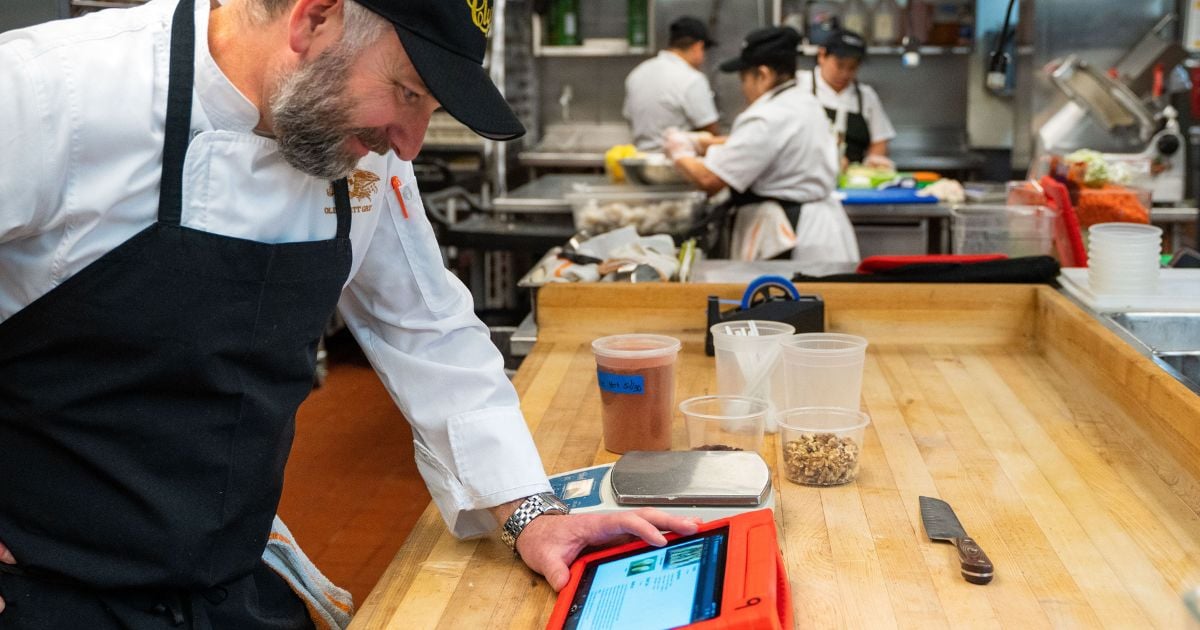
For this guide we tested and reviewed the platforms hands-on wherever a trial or demo was available, and verified each price against the vendor's own pricing page before publishing.
MarginEdge is a flat-priced, all-inclusive restaurant back-office platform that turns your vendor invoices and POS sales into daily food cost, P&L, inventory, and menu numbers — at $350 per location per month with no long-term contract. It's the right pick for an independent full-service or quick-service operator who is tired of hand-keying invoices and wants real food-cost visibility; it is the wrong pick if you're shopping for a POS, because MarginEdge doesn't ring up a single sale.
To be clear up front: MarginEdge is a back-office layer that sits on top of the POS and accounting system you already run. It does not take payments, print tickets, or replace your register.
What Is MarginEdge #
MarginEdge is a cloud and mobile platform built by former restaurant operators to automate the paperwork that eats a manager's night. You photograph or forward a vendor invoice; MarginEdge line-item digitizes it through its "Bill-E" processing, tracks every price change, and combines that purchase data with your POS sales mix (PMIX) to produce a daily profit-and-loss statement, theoretical-versus-actual food cost, usage and waste, and category-level menu engineering. The company's own framing is "control variable costs — not create them," and the pitch is narrow on purpose: it is the back-office companion to a POS, not a replacement for one.
It fits independent full-service and quick-service restaurants and bars that want to stop hand-entering invoices, multi-unit groups that need commissary-kitchen ordering and transfers between locations, and the accountants and bookkeepers who close the books for restaurant clients through a dedicated for-accountants workflow. Bar-heavy concepts add Freepour, a smart scale that speeds up back-bar liquor counts.
The operator-built heritage shows in where the product draws its line. MarginEdge doesn't try to be the all-in-one that also schedules staff and takes reservations; it concentrates on the one back-office job most independent restaurants do worst — knowing their true food and beverage cost day to day — and leans on integrations for everything around it. That focus is the whole value proposition and, for buyers who want a single platform to do everything, its main limitation.
Features #
Invoice processing #
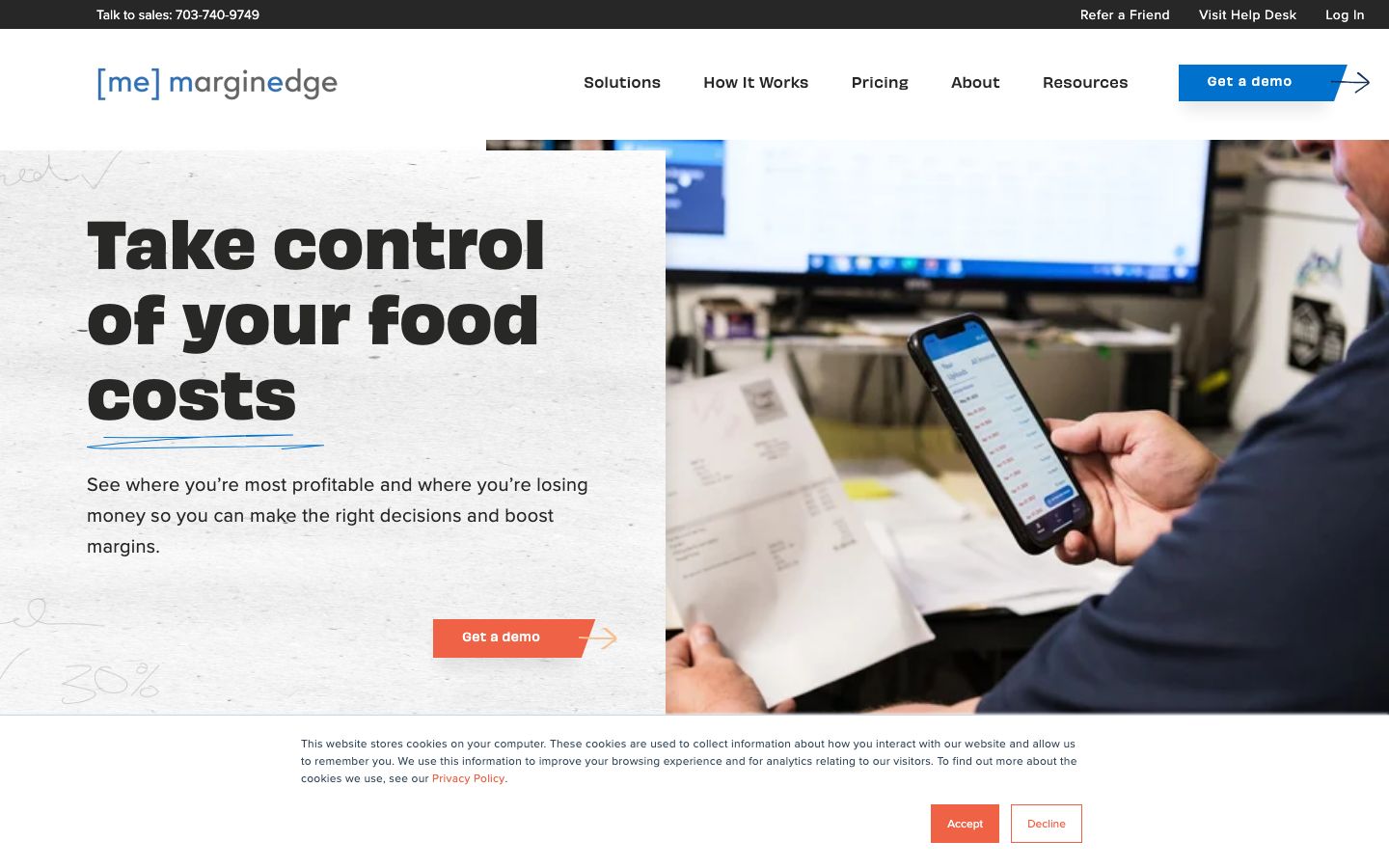
The core job is killing manual data entry. A manager snaps a photo of a delivery invoice or forwards the PDF, and MarginEdge digitizes it line by line — unlimited invoices on every plan, no per-document charge. As each invoice lands, it monitors product prices and fires an alert when a most-used item jumps, so you catch a supplier's cost creep the day it happens rather than at month-end.
Food cost and daily P&L #
Because purchases flow in as invoices arrive and sales flow in from the POS, the system builds a near-real-time cost picture and a daily P&L. An owner can see theoretical versus actual food cost each morning, track usage and waste, and tie a margin swing back to a specific product or recipe instead of waiting for the accountant's monthly summary. When theoretical cost and actual cost diverge — the classic signal of over-portioning, waste, or shrinkage — the gap is visible the next day while the cause is still fresh, not buried in a month-end close where nobody can act on it.
Inventory and ordering #
The team counts on-hand stock from a phone, and MarginEdge compares purchased versus sold versus counted to compute usage automatically — so a count that used to mean a clipboard and a spreadsheet becomes a walk through the walk-in with a device. For groups, commissary-kitchen orders and inter-location transfers are built in, so a central kitchen can produce and move product between units and keep each location's counts honest instead of letting inter-unit transfers vanish from the numbers.
Recipes and menu analysis #
Recipes are costed from live ingredient prices, and combined with PMIX sales data the platform runs category-level menu engineering — which appetizers, entrées, and desserts actually carry their margin and which are quietly losing money every time they sell. When a supplier price moves, the recipe cost moves with it, so a dish that was profitable in January can be flagged the week its key ingredient spikes, before the next menu reprint rather than after a season of eroded margin.
Bill Pay and accounting sync #
Bill Pay is free and unlimited for U.S. clients: an operator pays vendors from one place and gets free vendor-statement reconciliation (this is U.S.-only — Canadian clients don't get Bill Pay). Reconciled data then syncs out to the books — MarginEdge pushes cost and invoice data to QuickBooks, Xero, Sage Intacct, NetSuite, Restaurant365, Compeat, and M3, so the bookkeeper isn't re-entering anything.
Integrations #
MarginEdge pulls sales from a long list of POS systems — Toast, Square, Clover, SpotOn, TouchBistro, Lightspeed, Revel, Oracle Simphony, PAR, and many more — and connects to 7shifts for labor data. The flow is one-directional and purpose-built: the POS feeds sales in, MarginEdge turns them into cost numbers, and the accounting platform receives the reconciled result.
Pricing #
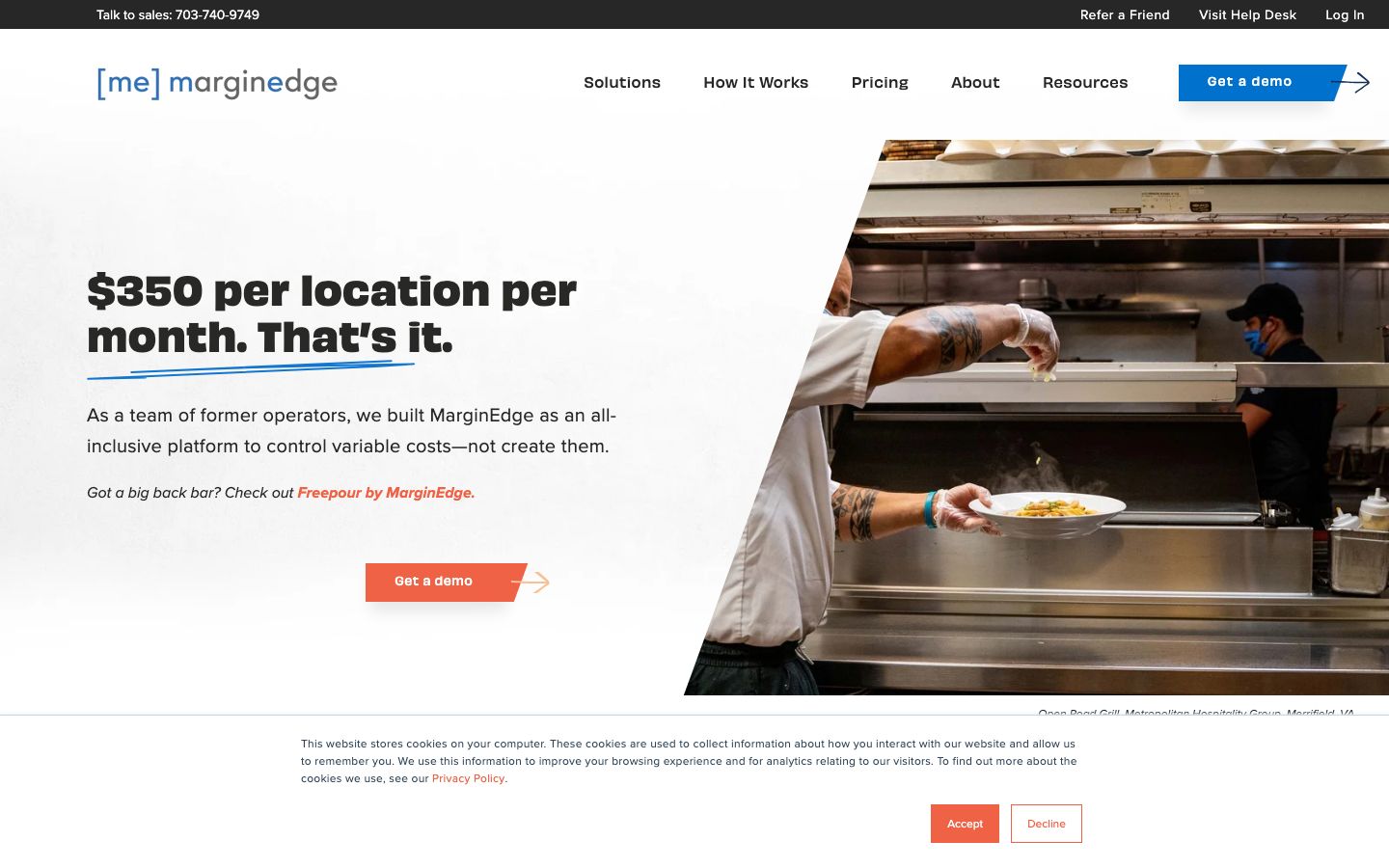
MarginEdge publishes its pricing, and it's genuinely flat — one all-inclusive rate per location, no per-invoice fees, no tiered feature gates.
| Plan | Price | What's included |
|---|---|---|
| MarginEdge | $350 / location / month | Unlimited invoice processing, price monitoring and alerts, inventory and food usage, recipes and menu analysis, daily P&L, free unlimited Bill Pay (U.S.), vendor-statement reconciliation, email support, 1:1 training |
| MarginEdge + Freepour | $500 / location / month | Everything above plus the Freepour smart scale for liquor counts (Freepour alone is +$150/location/month) |
| Annual billing | 10% off | A 12-month commitment; saves roughly $420/year on the base plan |
The contract terms are refreshingly plain. The month-to-month plan has no contract — you can leave any time. The annual plan trades that flexibility for the 10% discount and locks a 12-month term, and if you cancel mid-year the remaining balance of the term is still due, so take the annual rate only once you're sure the platform has stuck with your team. There are no traditional setup fees, though paid onboarding packages are offered — three tiers for one to four locations and bespoke pricing for five-plus — handled by a dedicated implementation team rather than a self-serve setup wizard. An unreturned Freepour scale carries a $500 charge, and sales tax applies in certain U.S. states and international markets, shown at checkout.
One cost catch matters if you run Toast: Toast charges a separate $50/location/month "Restaurant Management Suite" fee to open the API that feeds your sales into MarginEdge. It shows up on your MarginEdge bill but it's Toast's charge, not MarginEdge's, and it stays flat no matter how many integrations you add. Budget $400/location/month, not $350, if Toast is your POS.
Who It's For (and Who It Isn't) #
Good fit: independent full-service and quick-service restaurants and bars that are still hand-keying invoices and flying blind on food cost until the monthly books close. Multi-unit groups get real value from commissary ordering and inter-location transfers, and the flat per-location rate makes the cost predictable as you add units. Bar-forward concepts with a deep back bar should price in Freepour — the scale pays for itself if liquor counts currently take a manager hours. Restaurant accountants and bookkeepers get a dedicated workflow and clean syncs to the ledgers they already use.
Weaker fit: anyone shopping for a point-of-sale or a payment terminal — MarginEdge integrates with a POS, it is not one, and it processes no card payments. A tiny single-unit café running on a shoebox of receipts may not clear the math on a fixed $350/month tool. And Canadian operators lose the Bill Pay piece, which is a meaningful chunk of the value for U.S. restaurants.
Is It Legit and Worth It? #
MarginEdge is a privately held company run by people who came out of restaurant operations, and it earns strong third-party marks — 4.6 on Capterra from 47 reviews, matched by 4.6 on G2 from 31. The dominant praise is exactly what it sells: tight inventory and food-cost control, getting teams off spreadsheets, responsive support, and useful near-real-time reporting from one place.
For the core buyer the switching story is simple: it's the move away from spreadsheets and manual invoice entry toward automation that actually closes the loop between what you bought and what you sold. That's the single clearest reason restaurants arrive, and it's the thing reviewers say the platform delivers.
The honest knocks are worth pricing in. Operators report that vendor payment timing through Bill Pay can lag what they expect, so if a supplier needs same-day money, don't assume it. Some capabilities competitors already ship are still on MarginEdge's roadmap, and a few users find the integration and vendor-catalog navigation clunky to manage when they're setting up or hunting for a product. The Toast $50/month pass-through fee stings on principle even though it isn't MarginEdge's charge, and Bill Pay is U.S.-only, which quietly removes a big slice of the value for Canadian operators. None of these are dealbreakers for the core buyer, but they're the real-world texture behind the rating — and they read like the honest answer you'd get from another operator rather than the glossy version on the vendor's own page.
Alternatives #
- MarketMan — inventory and purchasing-first back office; a strong pick if ordering and supplier management matter more to you than daily P&L.
- Restaurant365 — accounting, inventory, and scheduling in one all-in-one suite; heavier and pricier, aimed at groups that want the ledger inside the platform.
- Craftable — inventory plus accounts-payable built for bars and beverage-heavy programs.
- xtraCHEF — Toast-owned invoice and food-cost automation; the natural comparison if you're already all-in on Toast.
- Compare the category in our restaurant inventory management software guide.
Login & Support #
Clients sign in through the MarginEdge web app (the customer login link on marginedge.com). Every plan includes unlimited email support and 1:1 software training for the team, and onboarding runs through a dedicated implementation team via the paid onboarding packages.
Estimate your MarginEdge cost
Uses published $350.00/location/mo starting rate. Updates as you type.
Estimator uses vendor-published list rates as anchor. Actual quotes vary by add-ons (member reporting, class scheduling, payment data feeds, active members tier) — request a written quote before signing.
Book a MarginEdge demo
Vendor-facilitated. We forward your request to their sales team within 24 hours.
- Choose a preferred date + time slot
- 30-minute product walkthrough
- Custom pricing based on your seat count
Screenshots
Pros
- Tight inventory and food-cost control is the dominant praise — this is what it does best
- Flat, all-inclusive $350/location/month pricing with no per-invoice or hidden fees
- Automated invoice processing frees managers from hand-keying and spreadsheets
- Near-real-time daily P&L and price-change alerts instead of a month-end surprise
- Bill Pay plus invoice management from one place (U.S.), with free statement reconciliation
- Responsive, well-reviewed customer support and included 1:1 training
Cons
- Vendor payment timing through Bill Pay can lag what operators expect
- Some features competitors already offer are still on the roadmap
- Integration and vendor-catalog navigation can be clunky to manage
- Toast users pay an extra $50/location/month Toast pass-through fee for the API feed
- Bill Pay is U.S.-only — not available to Canadian clients
- Not a POS or payment processor — it rides on top of your existing systems
Frequently Asked Questions
Similar Restaurant Inventory Management Software Tools
User Reviews
Write a reviewNo reviews yet for MarginEdge.
Be the first to review