
For this guide we tested and reviewed the platforms hands-on wherever a trial or demo was available, and verified each price against the vendor's own pricing page before publishing.
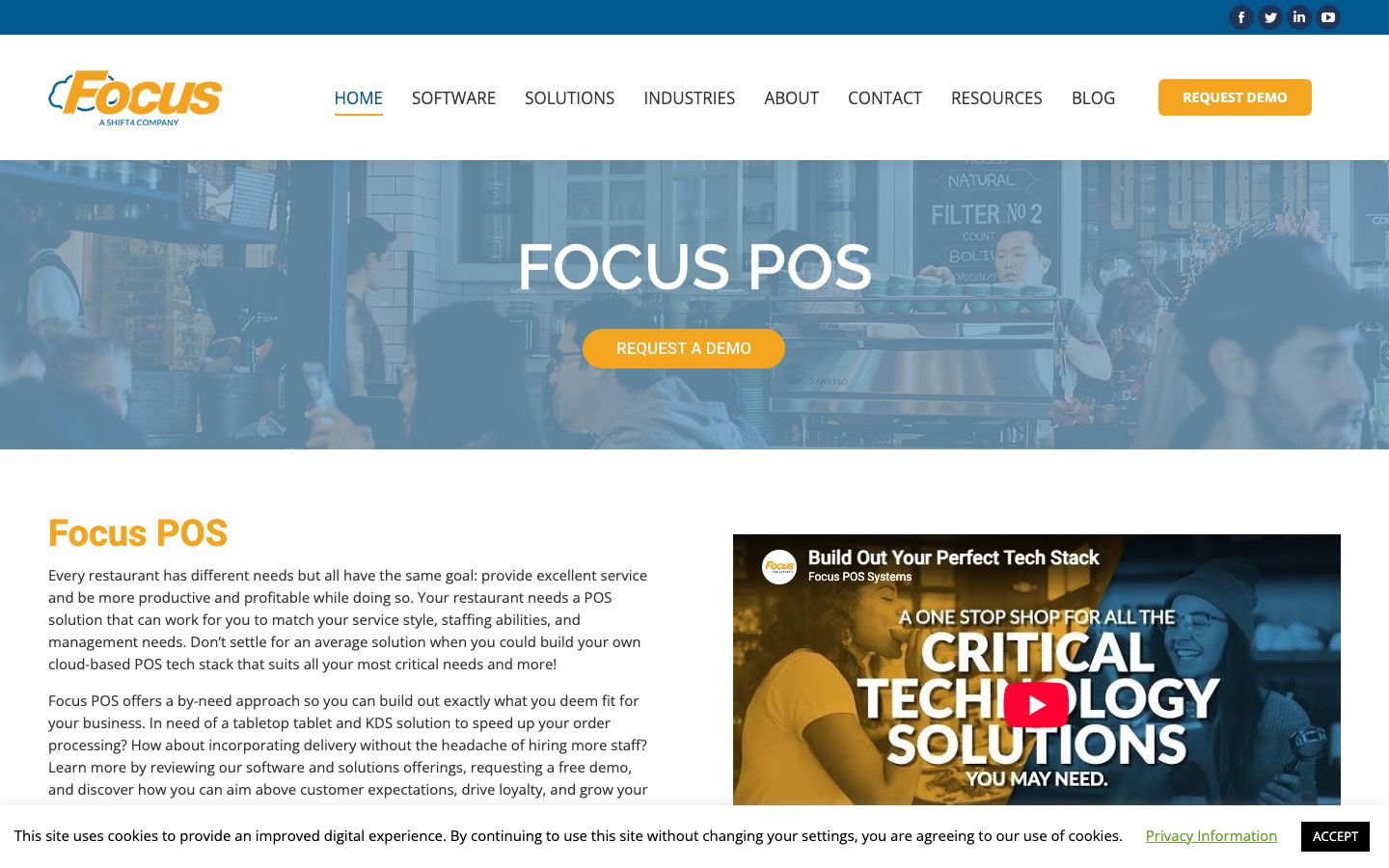
Focus POS is a dealer-sold, restaurant-specific point-of-sale platform that has been running full-service dining rooms, bars, and quick-service counters since 1990 — a good fit if you want a local expert to install the system and stay on the phone, and a poor fit if you want to see a price online and sign up the same afternoon. There is no public price list and no self-serve trial: you buy either a traditional software license or a monthly "Focus as a Subscription" plan through an authorized local dealer.
Focus POS Systems is an all-in-one restaurant POS and management platform — order entry, table management, reporting, and inventory in one system — not a standalone reservations, inventory, or payments-only product.
What Is Focus POS #
Focus POS is a hybrid on-premise-and-cloud restaurant platform: the core point of sale runs on local Windows terminals, tablets, and iPad, with cloud reporting and remote management layered on through its myFocus portal. It is built around touchscreen order entry and restaurant-native work — split checks, open tabs, transfers, voids and comps, and a graphic floor plan that shows table status and turn times at a glance.
The company has sold restaurant POS since 1990 and markets an installed base of more than 15,000 locations worldwide across table and counter service, takeout, delivery, bars, nightclubs, and cafés. Its marketing names marquee operators such as TopGolf, Second City Comedy Club, Smoothie King, Cold Stone Creamery, Arby's, and Popeye's as users — a vendor claim rather than an independently verified list, but one that signals the range of concepts the platform is configured for. Unlike direct-sold cloud systems, Focus goes to market through a channel of authorized local dealers who quote, install, and support the system in person — the two calls to action on its site are "Request a Demo" and "Find a Local Expert."
The platform is sold "by-need": you start with the POS and build out the tech stack a given concept actually uses — online ordering, a kitchen display system, loyalty, gift cards, and remote cloud management — rather than paying for a bundle you will not run. Focus maintains dedicated builds for quick service, fast casual, table service, bar and nightclub, café and coffee shop, pizzeria, frozen yogurt and ice cream, and franchise operators, so a multi-concept group can run the same platform configured differently per location.
Features #
Order entry and table service #
The floor runs on touchscreen order entry with full-service mechanics built in: servers split checks, open and transfer tabs, and apply voids and comps, while an interactive, customizable graphic floor plan shows table status, seat times, and even a pool-table timer for bar concepts. It is a system designed around how a server actually works a section, not a retail register adapted to food.
Kitchen display and order routing #
FocusKitchen is the dedicated kitchen display system: orders entered on the floor or taken online fire to the line by station, so the expo and line cooks work off the screen instead of a printer spitting chits. Combined with takeout and delivery management, dine-in, pickup, and delivery tickets land in the same kitchen queue.
Online ordering, delivery, and pay-at-table #
Focus takes direct online orders and routes third-party delivery through named integrations with DoorDash and Uber Eats. Its Order & Pay at Table, curbside, and QRPay options let a guest order and pay from the table or the curb by QR code, with MobilePay handling the tableside transaction.
Inventory and food cost #
The inventory module tracks stock, calculates menu-item costs, and surfaces usage reports, so a manager can see where food cost is leaking rather than guessing at the end of the month. Sales, labor, and inventory reporting tie back to the same data set.
Reporting and remote management #
Reporting covers sales, labor, and inventory, plus operator KPIs such as table turns and employee performance, sales-contest tracking, and theft-prevention data. Through myFocus, an owner pulls cloud reporting, a reporting dashboard, and mobile management from anywhere — and runs the loyalty program and gift-card modules from the same portal — which matters most to a multi-unit operator checking numbers across locations from one login.
Labor and security #
Time-clock and scheduling handle labor (scheduling is an optional add-on under the subscription plan). On the security side Focus ships PCI-compliant payment handling, fingerprint-ID access control, age verification for liquor sales, security-camera integration, and real-time alerts — the controls a bar or nightclub leans on to cut employee theft and comp abuse.
Accounting #
Focus syncs sales data to QuickBooks, exporting to simplify tax forms and profit-and-loss statements rather than rekeying the day's numbers into the books by hand.
Segment builds and franchise rollout #
Because Focus is assembled per concept, a bar runs tabs, a pool-table timer, and liquor age verification, while a quick-service counter runs fast order entry and a kitchen display, and a franchise group standardizes the menu and reporting across units from one platform. A Franchise POS configuration gives multi-unit owners consistent builds and roll-up reporting across locations, so a regional operator reviews sales and labor for every store from the myFocus dashboard instead of logging into each one.
Pricing #
Focus POS is sold by quote through local dealers — there is no public price list, and the site publishes no tier prices. Two buying paths are documented, and both are configured and quoted by a dealer:
| Option | What it is | Price |
|---|---|---|
| Traditional license | One-time software license bought through a dealer | Quote-only, not published |
| Focus as a Subscription (FaaS) | Pay for the software monthly, pay-as-you-go, with unlimited free upgrades and the ability to add terminals as you grow | Quote-only (monthly), not published |
The subscription plan is pitched as the low-entry-cost route — a top-tier POS without the upfront license — and lets a growing operator add terminals and components as traffic climbs. Optional modules carry an additional cost: labor scheduling, a hotel-PMS interface, customer-service/delivery tools, alerts, and gift cards.
On payments, Focus markets MobilePay and secure, PCI-compliant processing but publishes no rate card — no "X% + Y¢" figure. Payments run through the dealer's processor relationships rather than a single Focus-locked rate, so unlike a Toast or a SpotOn you are not forced onto the vendor's own card platform; the trade-off is that your effective rate is set in the dealer conversation, not posted online. To price Focus against anything else, you need a demo and a dealer quote — that is simply how this system is bought.
Who It's For (and Who It Isn't) #
Good fit: full-service restaurants and bars or nightclubs that want deep table management, tabs, split checks, liquor age verification, and anti-theft controls, and that value a local dealer who installs the system and picks up the phone when a terminal goes down mid-service. It also suits multi-segment and franchise operators who want one platform configured per concept, and buyers who are comfortable running a hybrid on-premise system rather than a pure cloud app.
The subscription plan lowers the barrier for a growing single-location operator who wants to add terminals as traffic climbs without a large upfront license, and the processor-flexible payments appeal to anyone who already has a merchant account they would rather keep than hand over to the POS vendor.
Weaker fit: an owner who wants transparent online pricing, a self-serve month-to-month sign-up, and no dealer in the middle — the modern cloud-POS buying pattern Focus deliberately does not offer. A single food truck or a tiny café chasing the lowest fixed monthly cost will find the quote-and-demo motion heavier than a Square or a Toast starter plan, and an operator who wants a natively-cloud app on an iPad they bought themselves will prefer a lighter system.
Is It Legit and Worth It? #
Focus POS is a legitimately long-lived product — more than three decades in restaurant point of sale and a large installed base — and the dealer model is a real strength for operators who want hands-on, in-person support instead of a ticket queue. For a busy bar or full-service room, a local expert who knows your install is worth a lot on a Friday night.
The honest cautions are structural. Third-party review samples for Focus are thin — only a handful of ratings exist on Capterra and G2, too few to present as an authoritative score — and the one recurring complaint that does surface is friction around payment processing, which tracks with the dealer-mediated, rate-by-quote model. Beyond the reviews, three facts are worth weighing: there is no public pricing, so every comparison requires a dealer demo; onboarding and support quality vary by local dealer rather than a uniform vendor SLA; and the architecture is a Windows-terminal lineage with cloud layered on, not a natively-cloud system — the public site still carries a 2023 copyright, consistent with a channel-led sales motion rather than a fast-iterating SaaS. For the right operator those are acceptable trade-offs; for a price-shopper they are the catch.
Alternatives #
- Aloha (NCR Voyix) — the other legacy, dealer-installed full-service and bar POS; processor-flexible like Focus, with a larger install base and a comparable in-person support model.
- Lightspeed Restaurant — a cloud, processor-flexible POS for full-service and multi-location groups that want online pricing and a self-serve path.
- TouchBistro — iPad POS for full-service restaurants wanting off-the-shelf hardware and a published monthly entry price.
- Clover — widely resold through banks and processors; a familiar choice if you want a dealer relationship but a cloud device.
- Compare the full field in our restaurant POS software guide.
Login & Support #
Operators sign in to cloud reporting and remote management through the myFocus portal (focuspos.com/myfocus). Support is delivered primarily through the network of authorized local dealers, who provide installation and in-person service, with a corporate Support contact listed on the Focus site as a backstop. There is no published self-serve support portal or 24/7 SLA on the public site — the dealer relationship is the support channel.
Book a Focus POS demo
Vendor-facilitated. We forward your request to their sales team within 24 hours.
- Choose a preferred date + time slot
- 30-minute product walkthrough
- Custom pricing based on your seat count
Screenshots
Pros
- Deep full-service and bar mechanics: split checks, open tabs, transfers, graphic floor plan, pool-table timer
- Local-dealer install and in-person support — a real strength for busy FSR and nightclub operators
- Processor-flexible: payments run through dealer relationships, not a single vendor-locked card rate
- Hybrid architecture keeps the POS running on local terminals plus cloud reporting via myFocus
- Strong security controls — fingerprint ID, liquor age verification, camera integration, anti-theft reporting
- Flexible buying: traditional license or monthly Focus-as-a-Subscription with free upgrades
Cons
- No public pricing — every quote requires a dealer demo, so comparison shopping is slow
- Payment-processing friction is the recurring complaint in the (thin) third-party reviews
- Onboarding and support quality vary by local dealer rather than a uniform vendor SLA
- Hybrid Windows-terminal lineage with cloud layered on, not a natively-cloud system
- Too few third-party reviews to establish an authoritative rating
- No self-serve, month-to-month online sign-up that newer cloud POS offer
Frequently Asked Questions
Similar Restaurant POS Software Tools
User Reviews
Write a reviewNo reviews yet for Focus POS.
Be the first to review