
For this guide we tested and reviewed the platforms hands-on wherever a trial or demo was available, and verified each price against the vendor's own pricing page before publishing.
Lightspeed Restaurant is a cloud POS that runs on off-the-shelf iPads rather than proprietary terminals, which makes it a strong pick for full-service restaurants, bars, cafés, and hotel F&B groups that want published monthly pricing and deep reporting without buying into one vendor's hardware. Software is clear — $69 to $399 a month in four tiers — but the add-ons stack fast: reservations, a kitchen display system, and full inventory each cost extra, and card-processing is negotiated per account rather than posted as a flat rate. If you run one quick-service counter and watch every fixed dollar, a flat-rate player will be cheaper; if you run a multi-revenue-center operation and want insights you can act on, this is built for you.
Lightspeed Restaurant is the hospitality POS sold by Lightspeed Commerce (NYSE/TSX: LSPD), a Montreal-based public company — not to be confused with Lightspeed Retail, a separate product for retail stores. This page covers the restaurant SKU only.
What Is Lightspeed Restaurant #
Lightspeed Restaurant is a cloud-based restaurant point-of-sale platform built for full service, quick service, bars and breweries, cafés, fine dining, and hotels. It runs on iPad — the pricing page lists dedicated business types for each of those segments — and stores data in the cloud rather than locally on proprietary boxes, which is the line Lightspeed draws against legacy on-premise systems.
Around the POS it bundles menu management, floor plans, integrated payments, and a reporting layer called Advanced Insights. Reservations, online ordering, advanced inventory management, and a kitchen display system are available higher up the tiers or as add-ons on any plan. The through-line Lightspeed sells is consolidation across revenue centers: a hotel or multi-location group can take orders, track inventory, and read performance across locations from one back office, with multiple revenue-center support for resorts.
Features #
Point of sale and floor management #
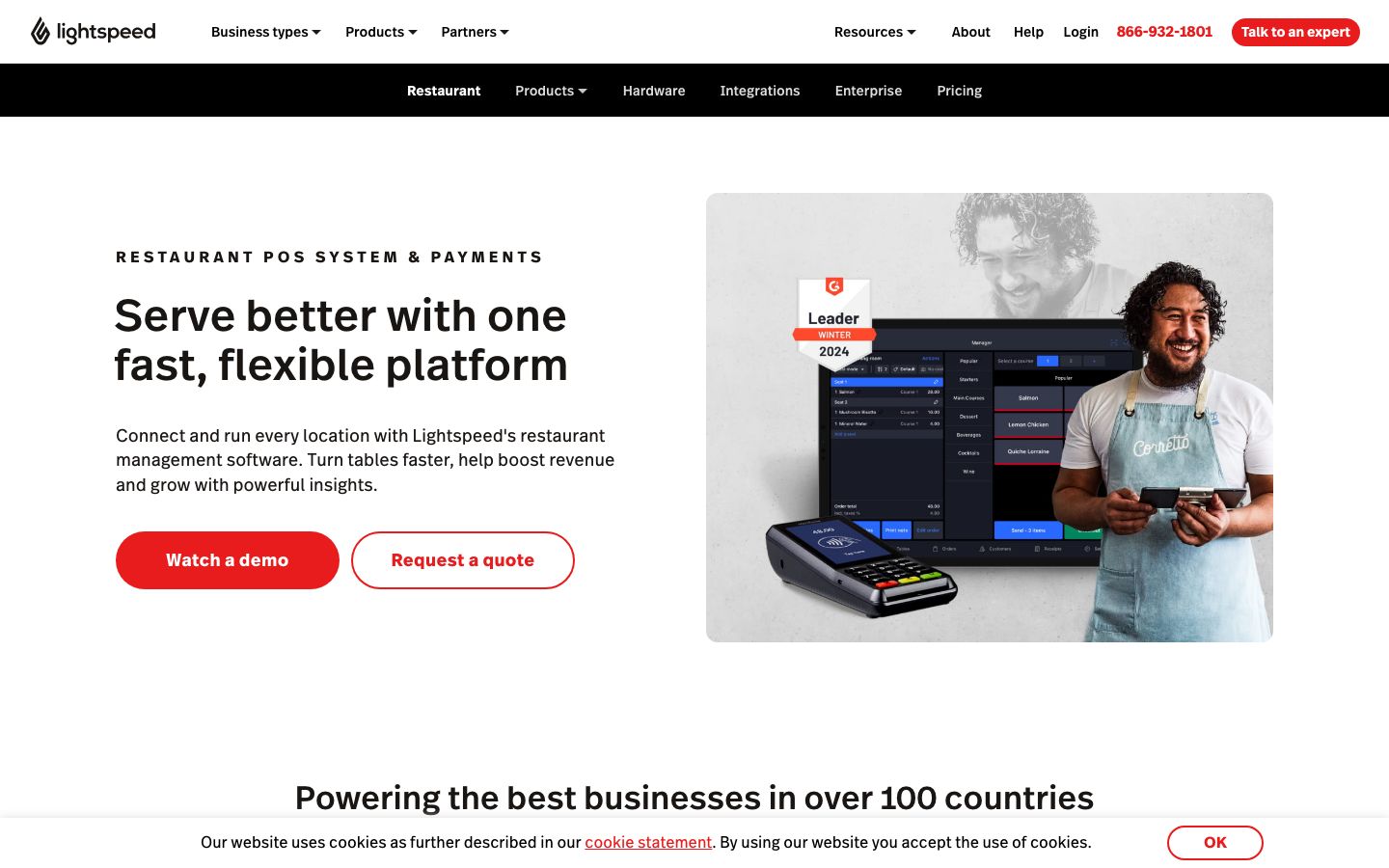
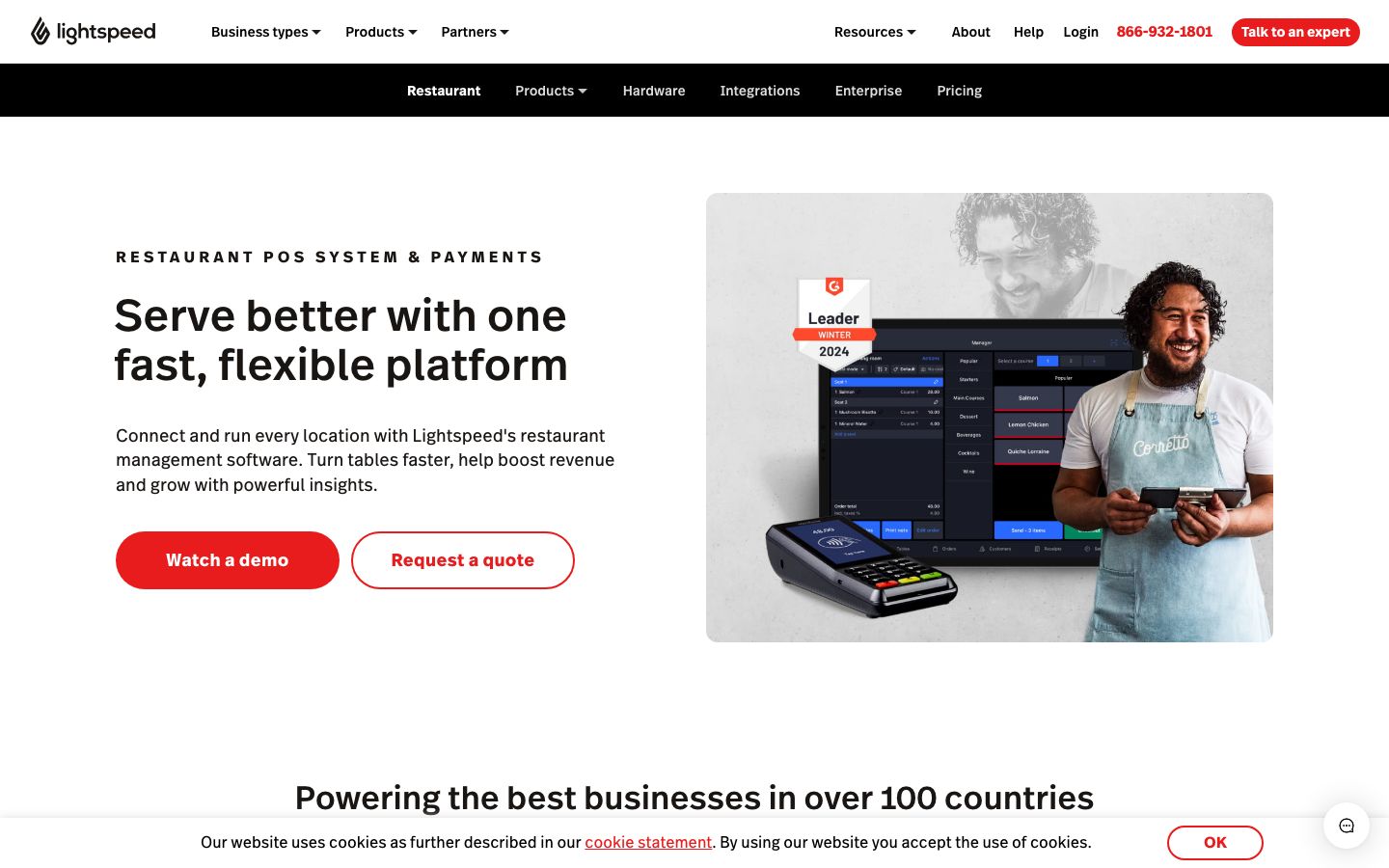
The core is a customizable iPad POS with menu setup, product options, modifiers, coursing, refunds, and stock management. The Menu manager controls screen layouts and sequences; Floor plans map sections, tables, and position numbers with live status views. Lightspeed Tempo manages service pacing so the kitchen isn't slammed by everything firing at once. A pre-auth bar mode lets staff swipe to open a tab and close it out in one tap.
Kitchen display and order types #
A kitchen display system routes tickets to the line by station, billed at $30 per screen per month on every tier. Take-out and delivery orders sit on a single screen alongside dine-in, and single-view reconciliation pulls payments and deposits into one view so the day closes without exporting between tools.
Online ordering, reservations, and delivery #
Order Anywhere gives you a contactless online menu for pickup and delivery, and Order and pay at table covers QR-code ordering so guests pay from their phone. Lightspeed Reservations and third-party reservation integrations are add-ons; the delivery add-on syncs your menu to major third-party delivery apps so those tickets land in the same flow instead of a wall of tablets.
Payments #
Integrated payments accept all payment types on and off premise. Tap to Pay turns an iPhone or Android into a contactless reader, and Pay at Table handles tableside payment. Lightspeed markets tight POS-plus-payments integration and defaults new Starter accounts to Lightspeed Payments; on higher tiers the payment terms show as custom, meaning they're negotiated rather than posted.
Reporting and inventory #
Advanced Insights is the reporting engine — the feature reviewers praise most — with Benchmarks and Trends, a Lightspeed Pulse mobile app to track performance across sites, and Lightspeed AI to ask natural-language questions about sales and food costs. Advanced inventory management tracks, orders, receives, and preps stock; it's a higher-tier feature also sold as an add-on. Raw API access on the top tier lets a developer pull back-end data to build custom workflows.
Integrations #
Lightspeed names 7shifts to handle scheduling and control labor costs, and OpenTable to manage reservations and reach more diners. Add-on categories cover PMS integration for hotels, accounting software sync, gift cards, and Lightspeed Capital financing. Beyond those named connections, Lightspeed runs a broader marketplace, but 7shifts, OpenTable, and the delivery/PMS/accounting add-ons are the integrations stated on its restaurant pages.
Pricing #
Software is a published monthly subscription in four tiers (USD, US pricing page). Payment processing is billed separately.
| Plan | Monthly price | Positioning |
|---|---|---|
| Starter | $69/mo | "Simplify your daily operations." |
| Essential | $189/mo | "Exceed guest expectations." |
| Premium | $399/mo | "Connect all of your departments." |
| Enterprise | Custom pricing (quote) | Personalized software-plus-hardware package, unlimited launch and consultation, dedicated support and a customer success manager. |
Watch the add-ons, because the base tier is lean. A kitchen display system is $30 per screen per month on every plan. Lightspeed Reservations and reservation integrations are add-ons across the three published tiers. Online ordering, contactless ordering, and order-and-pay-at-table are included on some tiers and available as add-ons on the rest. Advanced inventory management is a higher-tier feature, also sold as an add-on. Third-party delivery integrations require an add-on. A footer note states prices may vary by business type and industry.
On payments, Lightspeed does not post a flat processing rate. Its payments page states rates are structured as a percentage of the transaction amount plus a fixed fee per transaction, and that processing rates vary widely — in practice the rate is quoted per account, not published. That's the honest read: software pricing is transparent, card-processing economics are negotiated.
Who It's For (and Who It Isn't) #
Good fit: full-service restaurants, fine dining, bars and breweries, cafés, and especially hotels and resorts that need multiple revenue-center support and a PMS tie-in. Multi-location operators get management and reporting that roll up across locations, and the off-the-shelf iPad hardware means you aren't locked into a vendor's terminals. Operators who live in their numbers — food costs, benchmarks, trends — get the most out of Advanced Insights and Lightspeed AI.
Weaker fit: a single food truck or pop-up counting every fixed dollar, where a $69-plus-add-ons monthly software fee is heavier than a flat-rate app that charges only when you ring a sale. If your operation is one quick-service station with simple needs, the tiered software fee and à-la-carte add-ons can cost more than the feature depth is worth.
Is It Legit and Worth It? #
Lightspeed is a publicly traded commerce platform running restaurant, retail, and golf product lines, so this is an established vendor, not a reseller. It earns solid third-party marks — Capterra 4.4 from 216 reviews, G2 4.3 from 55 — with reviewers consistently praising ease of use, reporting and analytics depth, and overall feature breadth.
The complaints are worth pricing in before you sign. Customer support is the recurring theme despite the 24/7 marketing — when operators reach the right person it's praised, but reaching them is the friction. There's a learning curve, and onboarding and setup draw criticism. Cost is the other flag: because the base plan excludes reservations, full inventory, the $30-per-screen KDS, and delivery integrations, the add-ons stack up past the headline tier price, and reviewers call out both price and add-on cost. A few cite occasional bugs. None of these are dealbreakers for a mid-size or multi-unit operator, but build the real monthly number — tier plus the add-ons you actually need plus a quoted processing rate — before you compare it against anyone else.
Alternatives #
- Toast — all-in-one restaurant POS with payments, online ordering, and payroll under one vendor, but it locks you to Toast hardware and Toast processing.
- TouchBistro — another iPad POS aimed at full-service restaurants, often with a lower entry point, though reporting is thinner than Lightspeed's.
- Square for Restaurants — flat, published processing and a free tier; the simpler path for a café, food truck, or small quick-service counter.
- Clover — flexible POS with a broad app market, frequently sold through banks and resellers.
- Compare the field in our restaurant POS software guide.
Login & Support #
Operators sign in through the "Login" link in the Lightspeed site header, which opens the Lightspeed back office and the Lightspeed Restaurant app. Support is advertised as 24/7 — one line that covers POS, payments, and hardware together — and the Enterprise tier adds a dedicated support team plus a customer success manager. The US sales line is 866-932-1801.
Estimate your Lightspeed Restaurant cost
Uses published $69.00/mo starting rate. Updates as you type.
Estimator uses vendor-published list rates as anchor. Actual quotes vary by add-ons (member reporting, class scheduling, payment data feeds, active members tier) — request a written quote before signing.
Book a Lightspeed Restaurant demo
Vendor-facilitated. We forward your request to their sales team within 24 hours.
- Choose a preferred date + time slot
- 30-minute product walkthrough
- Custom pricing based on your seat count
Screenshots
Pros
- Runs on off-the-shelf iPads, not proprietary terminals — no hardware lock-in
- Transparent published software pricing in four tiers ($69/$189/$399/quote)
- Advanced Insights reporting, Benchmarks & Trends, and Lightspeed AI are the dominant praise
- Built for multi-location and hotel F&B with multiple revenue-center support and PMS integration
- Deep feature set: floor plans, service-pacing (Tempo), QR order-and-pay, pre-auth bar mode
- Named integrations for scheduling (7shifts) and reservations (OpenTable), plus Tap to Pay
Cons
- Customer support is the recurring complaint despite 24/7 marketing — reaching the right person is the friction
- Add-ons stack the real cost: KDS is $30/screen/mo, and reservations, full inventory, and delivery each cost extra
- Learning curve and onboarding/setup draw criticism from reviewers
- No published flat processing rate — Lightspeed Payments is quoted per account, not posted
- Occasional bugs and glitches reported by some operators
- Heavier than flat-rate apps for a single food truck or one simple quick-service counter
Frequently Asked Questions
Similar Restaurant POS Software Tools
User Reviews
Write a reviewNo reviews yet for Lightspeed Restaurant.
Be the first to review