
For this guide we tested and reviewed the platforms hands-on wherever a trial or demo was available, and verified each price against the vendor's own pricing page before publishing.
Olo is the enterprise digital-ordering platform for multi-unit restaurant brands that already run a POS and want to own their direct online channel, pull every DoorDash, Uber Eats, and Grubhub ticket into one feed, and keep their guest data — not a point-of-sale you put on the counter. If you run one café, a bar, or a food truck, this is the wrong tool: Olo layers on top of a POS, it doesn't replace one, and it's sold by enterprise quote, not a credit-card signup. If you run 50-plus locations and third-party apps are eating your margin and your data, it's built for exactly that problem.
Olo (online ordering, founded 2005) is a digital-ordering, payments, and guest-engagement layer — POS-agnostic by design — not a register, inventory counter, or scheduling tool.
What Is Olo #
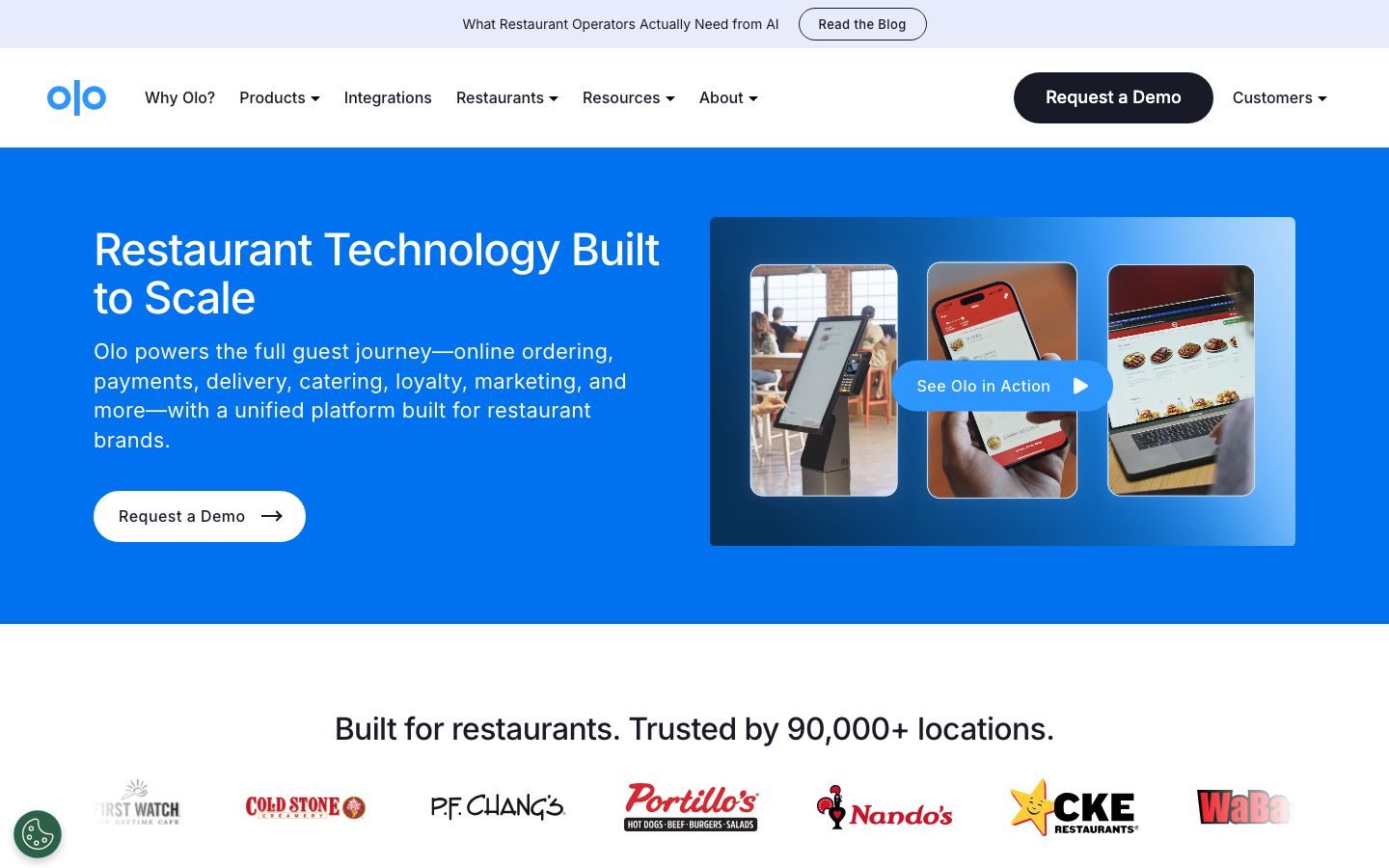
Olo is a cloud SaaS platform that sits on top of the POS a brand already runs and handles the digital side of the business: direct online ordering, third-party marketplace aggregation, delivery dispatch, payments, loyalty, reservations, and first-party guest data. It describes itself as an open SaaS restaurant platform, and it reports powering over 800 brands across roughly 90,000 locations, reaching about 108 million connected guests and processing more than 3.5 million orders a day.
The company started in 2005 sending text-message orders to restaurant printers — "two years before the iPhone" in its own telling. It traded publicly on the NYSE under ticker OLO until Thoma Bravo took it private in an all-cash deal valued at roughly $2.0 billion ($10.25/share); stockholders approved the sale on September 9, 2025, after which the stock was delisted. In December 2025 Olo folded in Spendgo to deepen its loyalty product. HQ is New York; founder and CEO is Noah Glass.
Olo is built for enterprise and multi-unit operators and runs two tracks — an Enterprise Brands program and an Emerging Brands program for smaller chains on the way up. The through-line is channel ownership: a brand uses Olo to take orders on its own branded storefront, consolidate the marketplace orders it can't avoid, and keep the guest relationship instead of renting it from an aggregator.
Features #
Ordering and the direct channel #
The core Ordering module runs a brand's direct digital-ordering system and connects to the POS already in place, so a web or app order drops into the same kitchen workflow as the rest of the business. Olo leans on a "100% ownership of guest data" claim here and publishes a 99.99% uptime figure for the ordering system. Serve is a no-cost, brand-owned ordering front-end — "launch fast, spend nothing" — aimed at higher conversion and larger checks without a custom build.
Marketplace aggregation and delivery #
Rails is the piece most multi-unit operators come for: it consolidates orders from the third-party marketplaces into the POS instead of a back counter stacked with tablets, covering 15-plus marketplace integrations and what Olo cites as roughly 99% of the delivery market. Dispatch handles direct delivery by routing each order to delivery service providers rather than making the brand run its own couriers; Olo reports 96% of its brands are covered by two or more DSPs at about a 28-minute average delivery time. Catering+ handles high-volume catering orders, and Order with Google and Switchboard (digitized phone orders) add more order channels.
Payments #
Olo Pay is a restaurant-specific payments layer with fraud and chargeback protection, Apple Pay and Google Pay support, in-store self-service kiosk payments, and passwordless guest checkout. Olo publishes performance figures from its 2024 online-payments data — a 96.7% authorization rate, 0.02% fraud rate, and 0.04% chargeback rate — presented as averages across its base rather than guarantees for any one brand.
Guest data, loyalty, and engagement #
Olo Loyalty runs a rewards program with first-party data capture (expanded by the Spendgo acquisition), the Guest Data Platform aggregates first-party guest data across channels, Marketing drives personalized campaigns off it, and Sentiment covers reputation management. Host adds reservation and waitlist management for high-volume dining rooms, and Sync manages local listings. Because the ordering, payment, and loyalty data all tie back to the same guest record, repeat-visit behavior stays with the brand instead of the marketplace.
Pricing #
Olo does not publish prices. There is no pricing or plans page — olo.com/pricing returns a 404 and no pricing link sits in the site navigation — and every product page's call to action is "Request a Demo." Pricing is set by quote through Olo's sales team per brand. That's how an enterprise platform like this goes to market, not a gap in the research.
| Item | What Olo publishes |
|---|---|
| List price / tiers | None — quote-only, enterprise sales, "Request a Demo" on every module |
| Olo Pay processing rate | Not published — quoted as part of the platform deal |
| Serve front-end | Marketed as a no-cost brand-owned ordering front-end ("spend nothing") |
| Contract | Enterprise agreement, negotiated per brand (term not published) |
The honest read: the only published price point is Serve's "no-cost" front-end, and whether that's truly free or bundled into a platform contract is a sales-framing question you settle at the quote stage. The broader suite — Ordering, Rails, Dispatch, Pay, Loyalty, Host — is priced per brand, so budget for a demo, a scoping conversation, and an implementation project rather than a published monthly rate.
Who It's For (and Who It Isn't) #
Good fit: enterprise and multi-location brands — high-volume QSR, fast-casual, and multi-unit full-service groups — that already run a POS and want to own their direct digital channel, aggregate marketplace orders through Rails, and keep first-party guest data instead of handing it to the delivery apps. The value compounds with scale: the more locations and the more marketplace volume, the more Rails and Dispatch earn their keep. Emerging chains on a growth path have a dedicated track.
Weaker fit: a single-location independent, a café, a bar, or a food truck looking for an all-in-one POS and register. Olo doesn't replace a POS, there's no self-serve signup, and the quote-only, enterprise sales motion isn't economical at one or two locations. A small operator is better served by an all-in-one POS that includes online ordering out of the box.
Is It Legit and Worth It? #
Olo is a real, established category leader — twenty years in restaurant digital ordering, a former public company now backed by Thoma Bravo, with one of the largest footprints in enterprise online ordering. For a multi-unit brand fighting marketplace margin and data loss, it's a serious, well-supported platform.
The honest cons are mostly about who it's for and what it costs to adopt. Cost is the top theme in its reviews — this is an enterprise, quote-only product that isn't economical for small operators, and the lack of transparent public pricing slows evaluation for any buyer trying to size it quickly. Onboarding is a project: enterprise implementation and integration setup across an existing POS and multiple delivery channels takes planning, not an afternoon. And because Olo is a layer rather than a POS, a brand without the in-house technical and operational muscle to run an integrated digital stack will feel the weight of that. Its own public review samples are thin (G2 4.4 from 18, Capterra 5.0 from just 3), which is typical for enterprise platforms sold by quote — small-sample scores, not a knock on the product.
Alternatives #
- Toast — all-in-one POS with built-in online ordering and DoorDash/Uber Eats/Grubhub consolidation; the simpler path for single and small multi-unit operators who want ordering and the register from one vendor.
- Square for Restaurants — transparent pricing and free online ordering bundled with the POS; the easy choice for a café or small QSR, not an enterprise aggregation layer.
- Lightspeed Restaurant — processor-flexible cloud POS with online ordering and delivery integrations for full-service and multi-location groups.
- SpotOn — restaurant POS with online ordering and strong support, pitched at independents and growing multi-unit operators.
- See the field in our restaurant online ordering systems guide.
Login & Support #
Brand operators sign in at the Olo Dashboard (linked as "Customers → Dashboard Login" in the site header). Support runs through Olo's Help Center and Support links, with enterprise onboarding and professional services part of the platform; press contact is [email protected].
Book a Olo demo
Vendor-facilitated. We forward your request to their sales team within 24 hours.
- Choose a preferred date + time slot
- 30-minute product walkthrough
- Custom pricing based on your seat count
Screenshots
Pros
- POS-agnostic by design — layers on the POS you already run instead of forcing a rip-and-replace
- Rails consolidates DoorDash/Uber Eats/Grubhub tickets into one feed (15+ marketplaces, ~99% market coverage)
- Keeps first-party guest data and loyalty with the brand instead of the delivery marketplace
- Serve offers a no-cost, brand-owned ordering front-end to launch a direct channel fast
- Olo Pay adds fraud/chargeback protection plus Apple Pay, Google Pay, and kiosk payments
- Proven at enterprise scale — 800+ brands, ~90,000 locations, 3.5M+ orders a day
Cons
- Cost is the top complaint — enterprise, quote-only, and not economical for small operators
- No public pricing; every path is "Request a Demo," which slows evaluation
- Onboarding is a project — enterprise implementation and multi-channel integration take planning
- Not a POS — must layer on an existing register, so it does not fit single-location independents or food trucks
Frequently Asked Questions
Similar Restaurant Online Ordering Systems Tools
User Reviews
Write a reviewNo reviews yet for Olo.
Be the first to review