
For this guide we tested and reviewed the platforms hands-on wherever a trial or demo was available, and verified each price against the vendor's own pricing page before publishing.
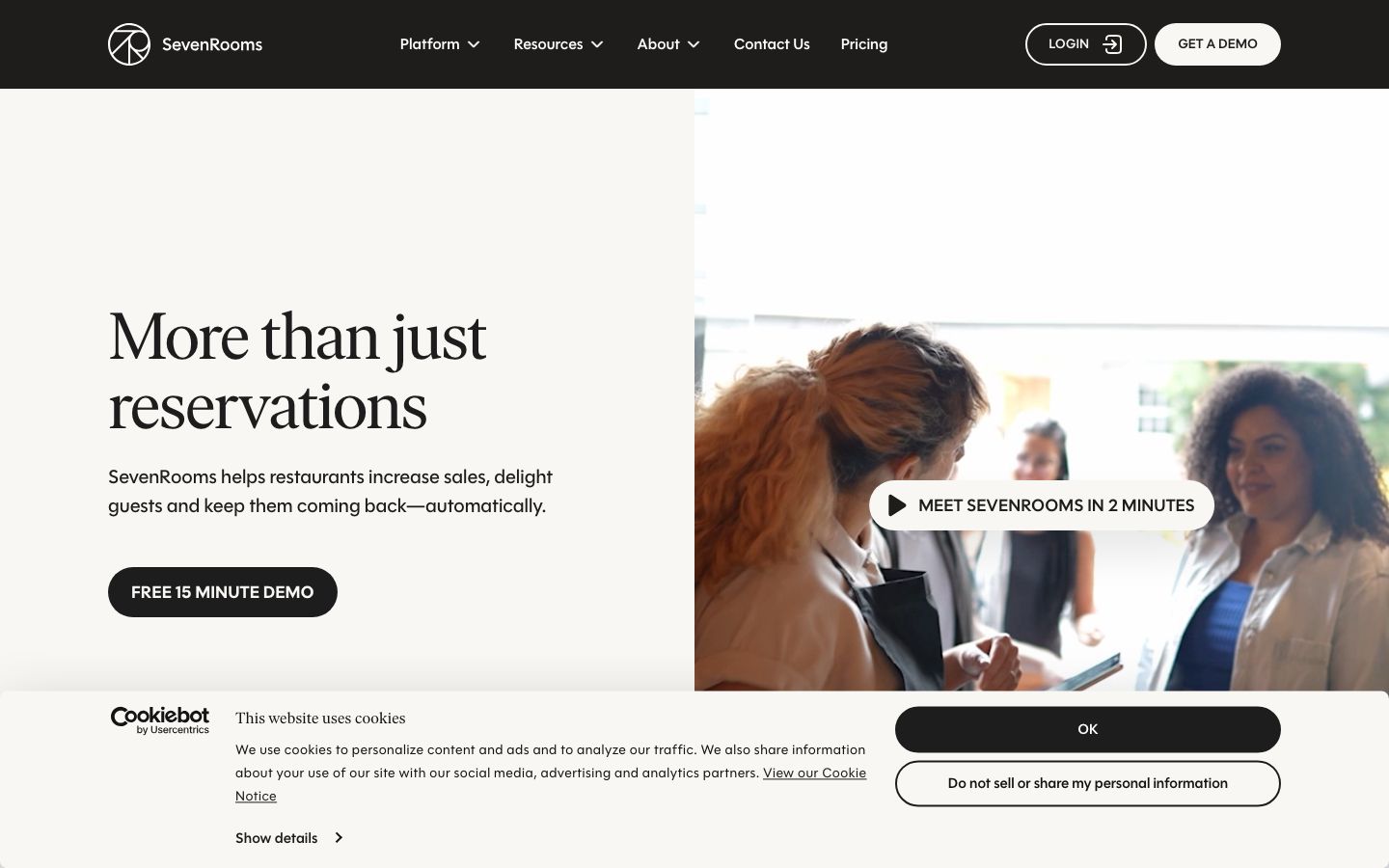
SevenRooms is the reservation, waitlist, and guest-CRM layer for full-service restaurants, bars, nightclubs, and hotel groups that want to own their guest data and turn it into repeat business — not a point-of-sale that takes orders or fires tickets to the kitchen. It's sold by quote with no public price, and it's now a DoorDash company, which wires its booking marketplace straight into DoorDash's consumer network. If you run reservations and want marketing and guest profiles that pay for themselves, it's a strong pick. If you're a counter-service spot with no booking model, it solves a problem you don't have.
SevenRooms is a guest-experience and reservation platform — you still run your own POS underneath it for tender and kitchen.
What Is SevenRooms #
SevenRooms is a cloud platform that pulls reservations, waitlist, table management, a guest CRM with unified profiles, reputation management, and marketing automation into one system. The differentiator is the data layer: every booking, visit, spend note, and preference ties back to a single guest profile, and that profile drives the marketing that brings guests back. Where OpenTable charges per cover, SevenRooms markets itself as commission-free on reservations — its DoorDash and Deliveroo marketplace bookings carry no cover fees.
The company sells across hospitality broadly — its "Who We Serve" lineup names restaurants, restaurant groups, hotels, membership clubs, nightclubs and bars, sports and entertainment venues, and breweries and wineries. SevenRooms states it is trusted by more than 15,000 restaurants worldwide. It operates as a DoorDash subsidiary; the pricing-page footer reads "© 2026 SevenRooms a DoorDash company."
The through-line is lifetime value: a guest books a table, the host seats them against a table-turn algorithm, their preferences and spend land on their profile, and a marketing automation later brings them back — all without the data living in a separate tool. For a group running several venues, the same guest is recognized across every room, and the operator sees demand and covers roll up in group reporting rather than reconciling each book by hand.
Because SevenRooms sits above the POS rather than replacing it, the practical question for a buyer is less "does it take orders" and more "will my venue actually use the guest data." The platform is built for operators who treat a filled seat as the start of a relationship, not the end of a transaction — which is why its sweet spot is reservation-driven hospitality with marketing budget and repeat-visit ambitions, not high-turn counter service.
Features #
SevenRooms organizes its product into three hubs.
Reservations, waitlist, and table management #
The core is branded reservations and waitlist management plus a table-management board. Hosts seat guests against an auto-seating / table-turn algorithm the vendor credits with turning tables more efficiently, and bookings also flow in from the DoorDash and Deliveroo reservation marketplace that SevenRooms puts in front of 50-million-plus consumers with no cover fee.
Guest CRM and profiles #
Unified guest profiles are the strongest-praised piece: each guest carries their visit history, preferences, allergies, spend, and notes, so the host stand and the server both work from the same record. This is the asset the rest of the platform monetizes.
Marketing automation and email #
The Marketing Hub covers CRM segmentation, marketing automation, email marketing, text and WhatsApp marketing, and search/social discovery. Automations trigger off guest behavior — a lapsed regular gets a win-back email, a birthday triggers an offer — turning the profile database into a repeat-visit engine. Email, text, and WhatsApp marketing are paid add-ons on top of the base subscription.
Events, loyalty, and reputation #
The Guest Experience Hub adds events and experiences with add-ons, a Private Line, loyalty and perks, and reputation management that consolidates reviews. Event management runs private dining with menus, minimums, and deposits, taking payments in one flow — useful for a venue where private events are real revenue.
Operations, reporting, and Voice AI #
The Operations Hub carries table management, revenue management, online ordering, reporting and group reporting, event management, Voice AI, Channel Connect, and the API. Revenue management shapes availability and pricing against demand so a Friday dinner service isn't booked the same way as a slow Tuesday. Voice AI answers guest calls and books reservations so the host stand isn't tied to the phone during a rush. Channel Connect pulls bookings in from outside channels, and a Group Portal add-on gives multi-venue operators cross-venue booking views and advanced group reporting — the manager sees covers, no-shows, and spend across every room from one dashboard instead of exporting each venue separately.
Online ordering is listed in this hub as well, though which features sit in the base tier versus the paid add-ons and higher tiers depends on the quote you're given — the Starter list that renders publicly covers core reservations, CRM, table management, reputation, and basic automations, with marketing, events, Voice AI, and the API priced separately.
Integrations #
SevenRooms advertises 100-plus integrations and a flexible API via its API & Integrations add-on, so the guest layer sits on top of the POS a venue already runs rather than replacing it. In practice that means the venue keeps its existing tender and kitchen system and lets SevenRooms own the booking, profile, and marketing side — spend and visit data flow back into the guest profile so the CRM reflects what each guest actually buys. The two channels named on the pricing page itself are the DoorDash and Deliveroo reservation marketplaces; specific POS and tech partners live in its integrations directory, and the API and integrations layer is a paid add-on rather than a base-tier inclusion.
Pricing #
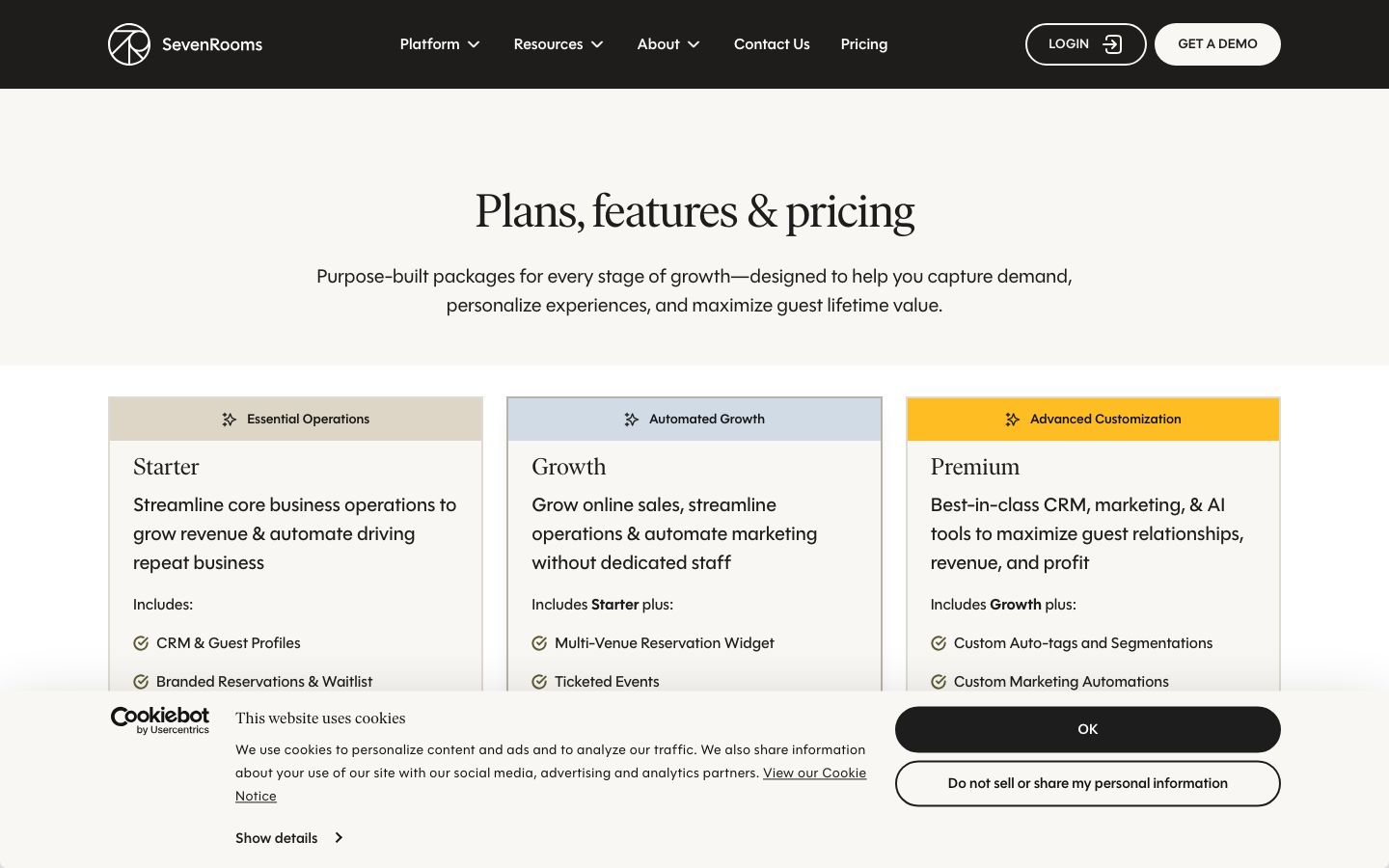
Sold by quote — no public price. SevenRooms publishes three named tiers but lists "Get a quote" for each rather than a dollar figure.
| Tier | Positioning | Price |
|---|---|---|
| Starter | Essential operations — core reservations, waitlist, CRM, and basic marketing to grow revenue and automate repeat business | Get a quote |
| Growth | Mid tier for operators scaling guest marketing and multi-channel demand | Get a quote |
| Premium | Top tier for groups and high-volume venues wanting the full data and automation stack | Get a quote |
The Starter tier includes CRM and guest profiles, branded reservations and waitlist management, access to the DoorDash and Deliveroo reservation marketplace, table management, reputation management, and basic marketing automations.
On top of the base subscription, SevenRooms charges for add-ons: email marketing, event management, Voice AI, WhatsApp and text marketing, API and integrations, and the Group Portal. SevenRooms' own FAQ acknowledges "costs aside from the monthly subscription fee," so the real figure is a base tier plus whichever add-ons you switch on — budget for both. There's no card-processing rate to weigh here: SevenRooms isn't a POS or a payment processor, though it does handle deposits and event prepayments through the platform.
Who It's For (and Who It Isn't) #
Good fit: full-service restaurants, fine dining, bars, nightclubs, and multi-unit restaurant groups that take reservations and want to own guest data and run marketing off it. The Starter-to-Premium tiering and the Group Portal add-on point squarely at growing and multi-location operators who need cross-venue booking views and group reporting. Hotels, membership clubs, and entertainment venues with food-and-beverage and events programs are a core segment too — the event-management module earns its keep where private dining is real revenue.
A bar or nightclub gets specific value here too: table and bottle-service management, event booking with deposits, and a guest profile that remembers the regular who spends on a big night. For hotels, the F&B outlets and private events run off the same guest record the property already cares about.
Weaker fit: counter-service QSR, food trucks, and cafés with no reservation model. SevenRooms is a demand and guest-experience layer, not an order-taking POS, so a quick-service operator gets little from it and still needs a separate system for tender and kitchen. Price-sensitive single-unit operators should also weigh it carefully — cost is the most common complaint, and the add-on model means the quote climbs as you turn features on. A small full-service spot that only wants a booking book without the marketing engine will pay for capability it won't fully use; a lighter reservation tool may fit better until the guest-data strategy is real.
Is It Legit and Worth It? #
SevenRooms is an established NYC-born platform now backed by DoorDash, serving 15,000-plus restaurants globally, and it earns strong third-party marks — Capterra 4.4 from 24 reviews and G2 4.7 from 76. Reviewers consistently praise the guest CRM and reporting, ease of use, support, and the breadth of having reservations, marketing, and guest data in one place. The DoorDash acquisition ties its booking marketplace to a large consumer network, which is a real demand advantage over a standalone reservation book.
The recurring complaints are worth pricing in. Cost is the top gripe — the base subscription plus paid add-ons adds up, and smaller operators feel it. Reviewers also cite reporting limitations on deeper or more custom analytics, occasional bugs, integration friction when wiring it to an existing stack, and a learning curve to get the full platform working the way it's pitched. None are dealbreakers for a reservation-driven venue that will actually use the marketing engine, but if you only need a booking book, you'll pay for capability you won't touch.
The honest read: the value lives in the guest data and the marketing it drives, so the venues that get the most out of SevenRooms are the ones with the staff and the intent to run campaigns, mine profiles, and work events — not the ones that just want a cleaner reservation screen. Priced by quote and layered on add-ons, it rewards operators who commit to the full guest-lifetime-value playbook and punishes the ones who buy it for one feature. Weigh the quote against the repeat-visit and marketing revenue you expect it to generate, not against the price of a standalone reservation tool.
Alternatives #
SevenRooms sits apart from the POS platforms in this catalog — most restaurants pair it with one rather than choosing between them. If you'd rather get reservations and guest data bundled into your POS instead of a separate layer, weigh these:
- TouchBistro — iPad POS with built-in reservations, loyalty, and marketing, a lower-cost route for a single full-service restaurant that doesn't need a dedicated guest-data platform.
- Toast — all-in-one POS whose Toast Tables adds reservations and a guest CRM tied to the check, if you want booking and ordering under one vendor.
- SpotOn — restaurant POS with reservations and marketing bundled in, often pitched to full-service venues that want fewer vendors.
- Lightspeed Restaurant — processor-flexible cloud POS for full-service and multi-location groups wanting integrated front-of-house tools.
- Compare the field in our restaurant reservation software guide.
Login & Support #
Operators sign in through the "Login" link in the top navigation at sevenrooms.com. Sales runs through "Get a Demo" and "Get a quote" CTAs and the Contact Us page, and a Trust Portal in the footer covers security and compliance. Support is a repeated praise point in third-party reviews — responsive onboarding and account help show up often in the positive column.
Book a SevenRooms demo
Vendor-facilitated. We forward your request to their sales team within 24 hours.
- Choose a preferred date + time slot
- 30-minute product walkthrough
- Custom pricing based on your seat count
Screenshots
Pros
- Unified guest profiles and CRM are the standout — visit history, preferences, and spend on one record
- Commission-free on reservations; DoorDash/Deliveroo marketplace bookings carry no cover fees
- Marketing automation turns guest data into repeat visits — email, text, and WhatsApp campaigns
- Strong fit for events and private dining with menus, minimums, and deposits in one flow
- Runs on top of any POS on standard devices — no proprietary hardware required
- DoorDash ownership wires the booking marketplace into a large consumer demand network
Cons
- Cost is the most common complaint — base subscription plus paid add-ons adds up fast
- Reporting is limited for deeper or more custom analytics, per reviewers
- Occasional bugs reported by some operators
- Integration friction when wiring it to an existing POS and tech stack
- Learning curve to get the full platform working the way it is pitched
- Not a POS — counter-service venues still need a separate system for tender and kitchen
Frequently Asked Questions
Similar Restaurant Reservation & Table Management Software Tools
User Reviews
Write a reviewNo reviews yet for SevenRooms.
Be the first to review